
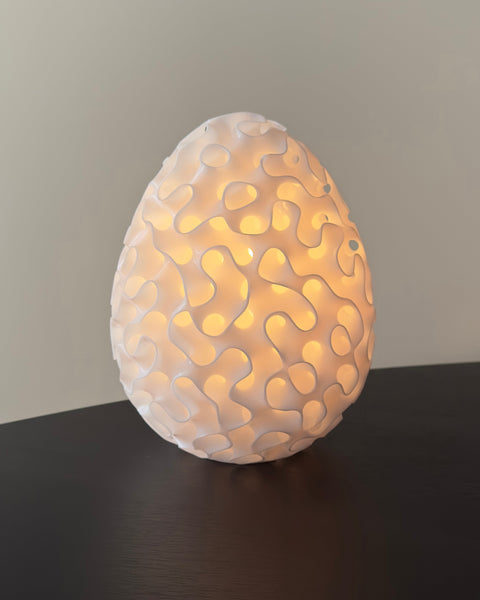
The Schwarz Surface: Nineteenth-Century Mathematics, Closed Into Light
Every lamp we make begins with a form nature or mathematics perfected long before us. Uovo began with both — and with a question a German mathematician asked one hundred and sixty years ago.
The shape a soap film knows
Dip a bent wire into soapy water and the film that forms across it is not arbitrary. Of all the surfaces that could span that wire, the film finds the one with the least possible area — pulled taut by surface tension until every point sits in perfect equilibrium with its neighbours. Mathematicians call these forms minimal surfaces: surfaces that curve everywhere yet waste nothing. They are geometry at its most economical — nothing added, nothing spare.
In the 1860s, long before computers could draw such things, Hermann Schwarz worked out something remarkable: a minimal surface that does not simply span a single frame but repeats — endlessly, in all three directions, like a crystal made of curvature instead of atoms. It divides space into two interwoven labyrinths that never touch, separated everywhere by a wall of mathematically perfect economy. He calculated it by hand and could only ever sketch fragments of it. The complete form existed nowhere but on paper, and in the imagination of the few who could read the equations.
A century and a half on paper
The Schwarz surface stayed theoretical for a simple reason: nothing could build it. It cannot be carved — a block conceals its interior from any tool. It cannot be moulded — the two labyrinths lock every mould inside itself forever. It cannot be assembled from parts without seams that betray the whole idea. For a hundred and fifty years, one of geometry's most beautiful objects had no physical existence at all.
What finally unlocked it was building the opposite way: not removing material, but growing the surface layer by layer — each cross-section printed in sequence, the way the mathematics itself describes the form. 3D printing did not just make the Schwarz surface easier to produce. It made it possible at all.
Nature got there first
Here is the part we find quietly humbling: while the mathematics waited on paper, nature had been building these structures all along. The iridescent green of certain butterfly wings comes from scales structured as periodic minimal surfaces, splitting light into colour. The inner architecture of bone follows the same logic — maximum strength, minimum material. Engineers now borrow these geometries for heat exchangers and for the scaffolds that help new bone grow, because a surface that wastes nothing turns out to be extraordinarily good at almost everything.
A minimal surface, in other words, is not an ornament. It is one of nature's deep solutions — the same quiet optimisation that shapes a snowflake or a shell, written in a more secret language.
Closing the infinite into an egg
An endless lattice is a mathematical object; a lamp is a domestic one. The work of Uovo — Italian for egg — was persuading the two to meet: taking a fragment of Schwarz's infinite surface and closing it into a single, self-contained form that can sit on a table. Bending a minimal surface into an egg without breaking its internal logic was a puzzle of its own, building on the two years spent learning to print the open surface — and it asked for a material precise enough to honour it — our UV-cured EcoLux resin, printed to order, dense and seamless, with hundreds of open cells left exactly where the mathematics puts them.
Unlit, Uovo reads as sculpture: a dense, matte object, geometry at rest. Switched on, it reverses. Light moves through the open cells and the slightly translucent walls, and the lattice reprints itself across the table as patterned shadow — the nineteenth-century equations, cast at domestic scale, an arm's reach from your chair.
Why we work this way
We could decorate objects with mathematical motifs; plenty do. We would rather let the structure be the object — choose a form because it is true, then get out of its way. It is the same conviction behind every piece in the studio: the six-fold order of ice crystals in our pendant lights, the pressed strata of glaciers in Lamella, and Schwarz's patient geometry in Uovo. Nature structures rather than decorates; we just add the light.
Uovo is the second piece in our Schwarz series — it began with Schwarz Minimal Surface #1, the lattice in its open, endless form. Both are 3D-printed to order among our sculptural table lamps, and ship worldwide, free.


