
Arranged, and Arranged Again: Living With Vases the Morandi Way
Giorgio Morandi painted the same handful of bottles for forty years and never repeated a picture. That is not a limitation. It is the entire lesson.
The painter who never ran out
In a single room on Via Fondazza in Bologna, Morandi kept a small cast of objects — bottles, boxes, jugs, vases — and spent a lifetime arranging them. He would move a bottle two centimetres and find a new painting. He let dust settle on them because the dust softened their edges. He painted over their labels and dulled their reflections until nothing was left but shape, weight and the space between. Critics kept waiting for him to move on to grander subjects. He knew there were none: nothing is more abstract than reality, he said — and he proved that a shelf of quiet vessels contains more compositions than one life can exhaust. (His full story is here.)
What he knew about arrangement
Look closely at his still lifes and a quiet grammar appears. The objects stand close — closer than feels polite — so they read as one family rather than a queue of individuals. Heights vary, but gently: a tall neck beside a low shoulder, never a skyline. The palette holds to a few earthy tones, so the eye reads form instead of colour. And around every group he leaves emptiness — the table's bare edge, the wall's soft field — because the space around an arrangement is what lets it breathe.
The same grammar, on your shelf
Everything he knew translates directly to the objects in your home:
Group close. Vases spaced evenly along a shelf are storage; vases gathered until they almost touch are a composition.
Vary the heights, keep the family. Three different silhouettes in one palette will always resolve; three identical shapes rarely do.
Let one thing be empty. Not every vessel needs flowers. A group where one vase holds a stem and two hold nothing reads as deliberate — a still life, not a bouquet.
Then move them. This is the Morandi secret: the arrangement is never finished. Shift one piece, and the whole composition changes. He made forty years of art this way; a shelf can give you a new room every month for the price of two minutes.
Two sets, two temperaments
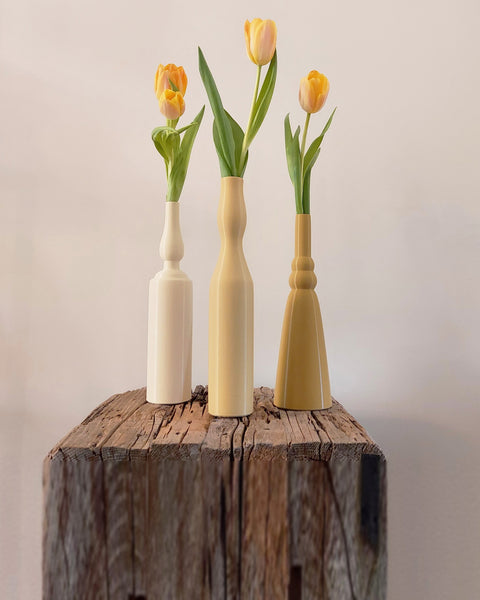
We shaped our Classic Collection for exactly this practice: three silhouettes in his own register — sand yellow, light ivory, ochre — each a different height, none louder than the others, watertight and endlessly regroupable. It is the painter's grammar, made physical.
And for the opposite temperament there is the International Klein Blue set — the same quiet silhouettes surrendered to Yves Klein's depthless ultramarine. One set recedes into the wall; the other refuses to. Both obey the same rule: arrange, look, rearrange.
Both sets are 3D-printed to order and ship free, worldwide — part of our vase collection.


