
Printed, Not Moulded: The Craft of 3D-Printed Lighting
Every Morandi piece is printed, not moulded. This is not a production detail — it is the reason the collection can exist at all. A short tour of how your lamp is actually made.
Why print at all?
Industrial lighting is moulded, and moulds have rules. A form must release from its tool, so interiors stay simple, undercuts are forbidden, and complexity is priced by the cavity. Most of what you see in lighting shops looks the way it does because a mould allowed it.
The forms we work from — a minimal surface that interlocks with itself, the six-fold lattice of an ice crystal, strata pressed like glacial ice — break every one of those rules. No mould can release them; no lathe can reach inside them. Building the object as the mathematics describes it, one thin layer at a time, is the only way these geometries can leave the computer and enter a room. 3D printing is not our gimmick. It is our only door.
Layer by layer, to order
When you place an order, your piece does not leave a shelf — it does not exist yet. The printers begin that day or the next, drawing the form in layers finer than a millimetre, over hours of uninterrupted work. Each piece is then finished, fitted and quality-checked by hand, and ships within one to three business days of your order.
Made-to-order changes more than logistics. There is no warehouse of unsold stock, no over-production quietly written off — nothing is made that is not already wanted. For an object meant to last a lifetime, we find it fitting that it begins its life wanted.
The material question
We print in EcoLux, our family of plant-based materials derived from renewable sources — corn starch, sugarcane. Two members of the family do the work: a bio-based polymer with a soft matte surface for most of the collection, and a UV-cured bio-based resin where a form demands finer, denser walls. Neither is a compromise reluctantly accepted; both were chosen for qualities synthetic plastics struggle to match — the warm, organic way they hold colour flat and even, and the gentle translucence that turns a shade luminous the moment the bulb behind it wakes.
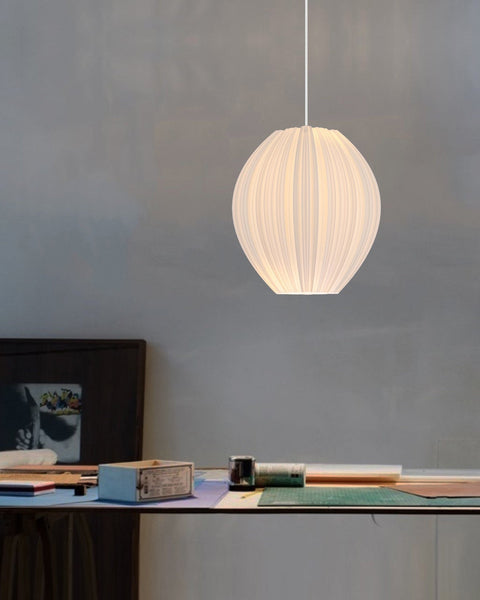
That translucence is the collection's quiet trick: every lamp is designed twice. Off, a matte sculpture with its geometry drawn in shadow. On, the material itself appears to hold the light.
Honest answers to fair questions
Does a printed lamp last? The included LEDs run at two to six watts and stay cool, well within the material's comfort — and every piece carries our International Lifetime Warranty, without fine print.
Do the layers show? Up close, some pieces carry their fine strata like a fingerprint of the process — we consider that a truth, not a flaw, and finish every surface until it earns its place at arm's length.
Is it really more sustainable? Plant-based material, printed only on demand, shipped once, made to be kept for decades. We would rather make fewer, wanted, permanent things than many disposable ones — sustainability by not producing waste in the first place.
Explore the results: sculptural pendant lights, table lamps and vases — each printed to order, each shipped free, worldwide.


